11/2/2024
What are Garter Snakes?
Garter Snakes (Thamnophis spp.) are a family of colubrid snakes species native to the North and Central Americas. Being part of the colubrid group means that they are not constrictors and are not front-fang venomous (like typical venomous snakes). They are fairly harmless snakes and tend to be very hesitant to bite. The care between species is very similar with the main differences being coloration and temperament. Some common garter snake species in captivity include:
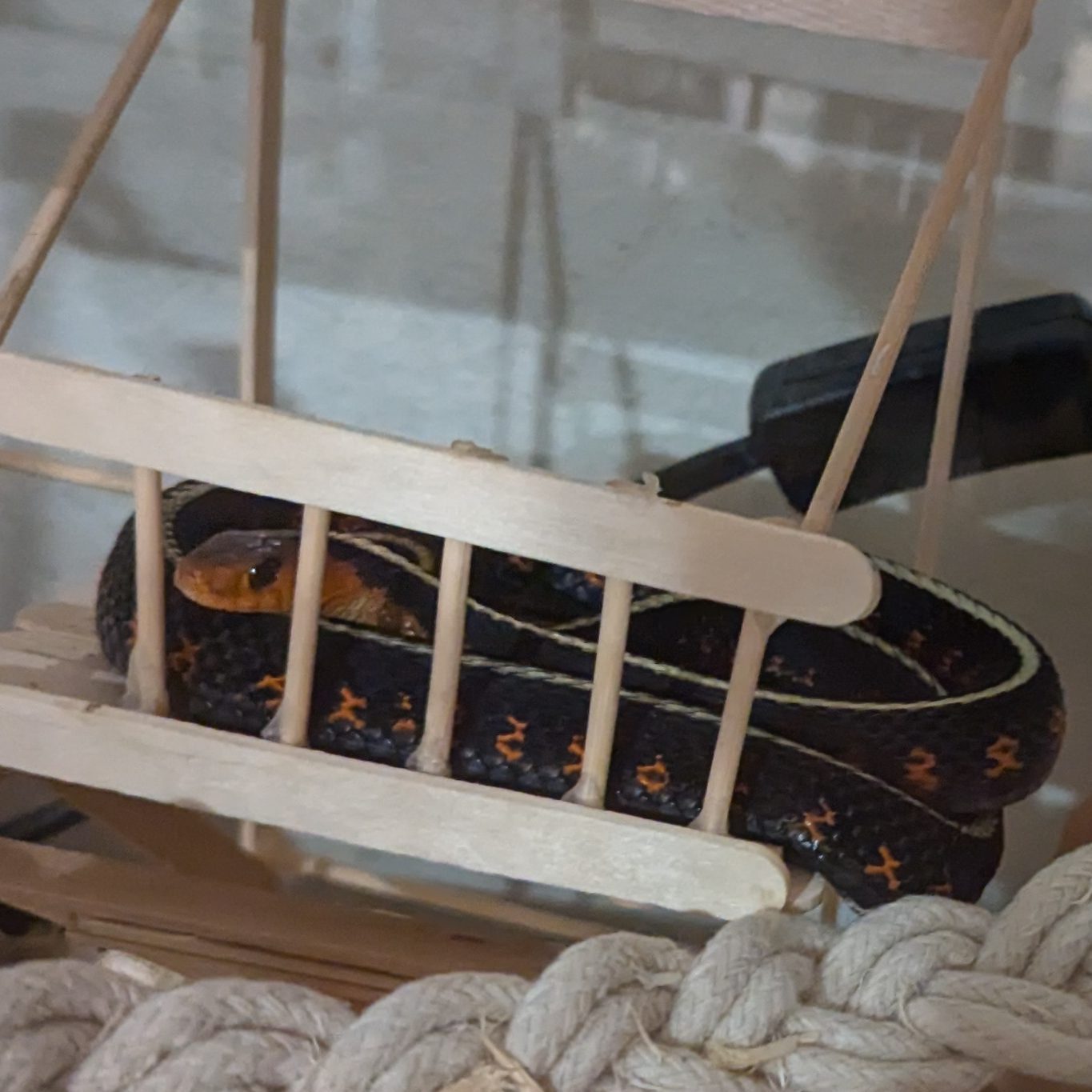
- Checkered Garter Snake (T. marcianus)- These snakes tend to be thicker and less exploratory than other species. They are typically docile and very food excited. They also typically enjoy burrowing and hiding so hides and substrate that can maintain tunnels should be used.
- Red-side Garter Snake (T. sirtalis)- There a several subspecies of red-sides all with different coloration and patterns but they tend to be similar in both care and temperament. They tend to be active, highly curious snakes. They enjoy having new things to explore so periodically swapping tank decor or moving things around can provide enrichment for them.
Habitat
One of the most important things to consider in a garter snake enclosure is securing any gaps or openings. Garter snakes are very thin, curious, and clever, a combination that makes them incredibly skilled escape artists. If there is a way out, they will find it.
In terms of tank set up garter snakes do not have many special requirements. They prefer to have a substrate that will hold tunnels. While a bioactive substrate could work, it would be important to prevent overwatering which could lead to scale rot or bacterial/fungal overgrowth. For this reason I recommend a dry substrate such as aspen fiber which maintains tunnels and is small enough pieces that it is unlikely to cause issues if ingested. If using dry substrate, a humid hide (container the snake can freely enter and exit filled with damp sphagnum moss) should be provided to aid in shedding. Note: do not use cedar substrate as it is highly toxic to reptiles.
As stated, many garter snakes are very curious, so objects should be added to the enclosure for them to explore. These objects could be practically anything: commercial hides, rocks, sticks, rope bridges, bark, toys, paper tubes, etc.. Just make sure that there are no narrow spots that the snake could get stuck in or sharp spots that could cut them.
Enclosure Sizing
They size of the enclosure should reflect the size of the snake. The size of the snake will depend both on their age, their gender, and their species. Typically adult garter snakes grow to 2-3 ft long with the largest documented snake being just over 5ft. In general a garter snake’s enclosure should be at least as long as they are, at least 12in wide(ideally more), and at least 18in tall. Typically a 15-20gal tank will be large enough. This allows space for the snake to maneuver through the enclosure, to add in appropriate enclosure furnishings, and to create a temperature gradient. Note: these are minimum requirements, for adults larger enclosures are appreciated.
If you are choosing to house multiple garter snakes together, there should be more space provided. An extra 4-6 inches in width or 5-10 gallons per additional snake should be acceptable, but more is recommended. Make sure there is enough space to add extra hides and enough space for the snakes to separate from each other if desired.
Cohabitation
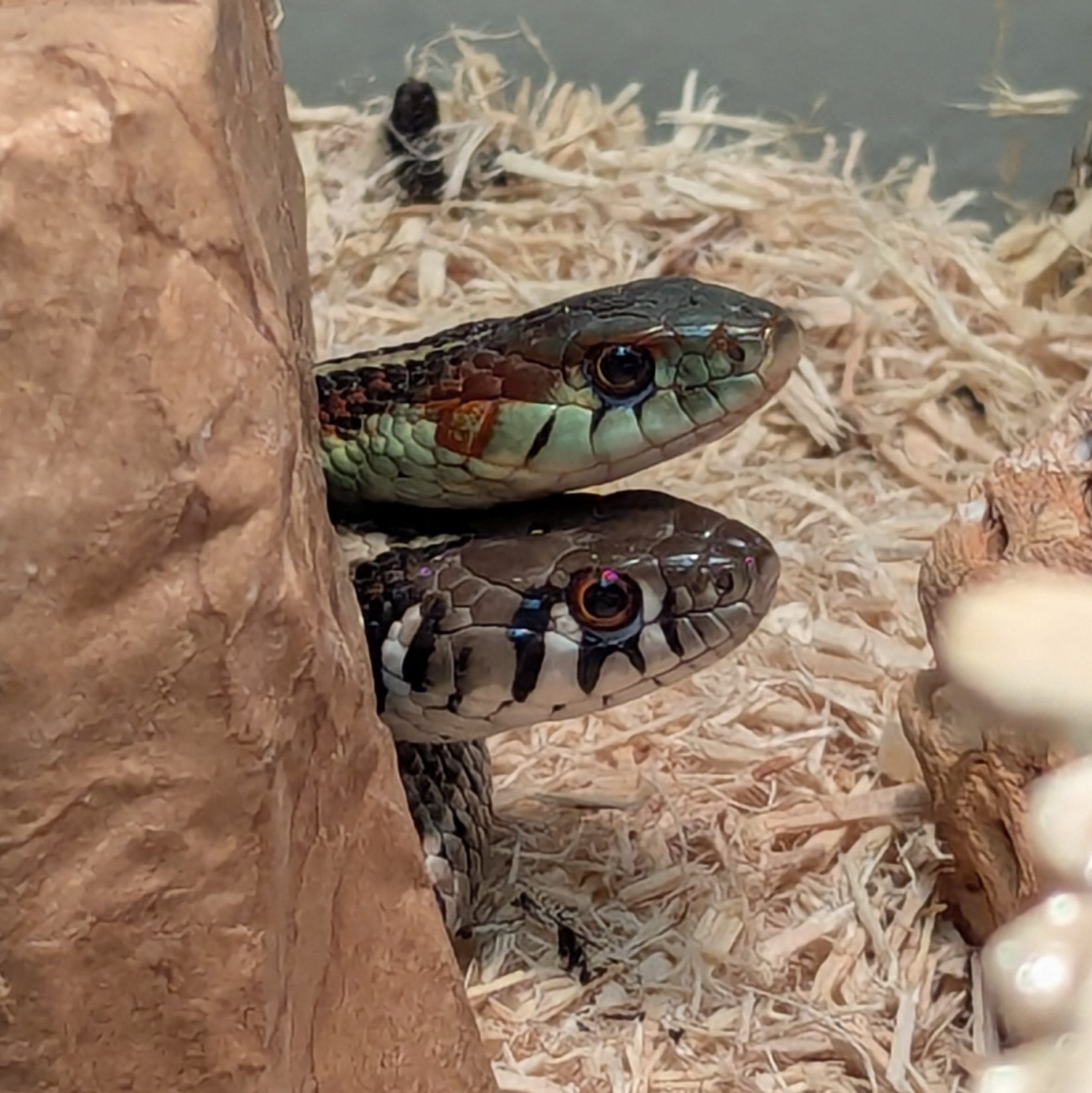
One of the things that may attract people to garter snakes is that, unlike many other types of snakes, they can be housed together, however this may not be the best option for every snake.
In many cases housing multiple young snakes together can be useful in encouraging them to eat and be less skittish. If they are similar in size there is usually not an issue with housing young snakes together, just make sure that if they are fed together, the food must be cut small enough that only one can grab a piece at a time.
Cohabitating adults or subadults is often successful, however, there are more factors to consider. Firstly, only snakes of similar size should be cohabitated or there is potential that the smaller one could be eaten. Snakes with a particularly strong feeding response should not be housed with others in order to prevent bites between the snakes. Whether a snake can be successfully cohabitated should be accessed on an individual basis and if attempting a new habitation situation they should be carefully monitored for signs of stress, defensiveness, or aggression. When cohabitation is successful it can result in less skittish snakes that are better able to cope with stresses but safety is the top priority.
Feeding
Garter snakes, like other snakes, are obligate carnivores, they must eat meat and animal protein. Unlike other snakes, garter snakes do not need to be fed whole prey. If you do choose to give incomplete prey a variety should be given to ensure proper nutrition. Any food given should be no wider than the snake’s head. Length of the food is less important, but some snakes may be intimidated by particularly large pieces. Food can either be tong fed or left in the cage (ideally on something that prevents it from picking up substrate). Some snakes require movement to trigger their feeding response and may respond better to food being offered by tongs. Some common food options include:
- Mice – Mice are an acceptable whole prey item for garter snakes. I always recommend frozen-thawed mice if at all possible as it limits parasite and injury risks to your snake. Typically pinky or fuzzy mouse should be a good size for adult garter snakes. Baby snakes are so small that even the smallest mice are too big so if you intend to feed them the mice will need to be cut into smaller pieces and, unless you make sure the babies get all parts of the mouse, may not provide full nutrition. If feeding mice, they should be given 1-2 times per week.
- Fish – Fish can be provided as whole prey items or as pieces cut from a larger fillet. The main consideration is that only thiaminase free fish should be given. If a garter snake consumes too much thiaminase it can lead to seizures and death. Again, I recommend frozen-thawed fish to minimize parasite exposure. Some people claim that fish makes garter snakes’ feces smell worse, I have not noticed a difference.
- Fish Fillet- One of the benefits of fish fillets is that they are very easy to cut into properly sized pieces. If fillet pieces are given, other food, such as organ meat, should also be incorporated into the diet to give them variety. A possible schedule would be to feed the snakes twice per week, alternating between fish and organ meat.
- Whole Fish- If feeding whole fish, they should be given 1-3 times per week. Fish fillet should be given in conjunction with other food items
- Organ meat – Having organ meat in their diet is important in order for them to get all of the nutrients they need. Various organ meats can be found at most grocery stores. Mammal meat tends to be higher in fat, so typically it is better to stick to poultry meat. Chicken hearts are one of the most common options due to being easy to work with, however, they can be high in fat so should not be over fed. A possible schedule would be to feed the snakes twice per week, alternating between fish fillet and organ meat.
- Snail/Slugs – Snails and slugs are natural prey of garter snakes and provide good nutritional value. DO NOT feed wild snails and slugs to your snakes, they can be filled with parasites which may be harmful to your snake. Live, captive slugs/snail can be difficult to find so are not commonly fed to garter snakes. It is more common to use commercially prepared slugs/snails.
- Supplements – While not food themselves supplements are important for getting garter snakes all of the nutrients they need. Reptile vitamins and calcium supplements can be sprinkled onto the provided food items. I personally use ZooMed’s supplements, but other brands are available. If you do not provide UVB lighting, make sure that either the calcium or vitamin supplement has vitamin D3 added, it is necessary for the processing of calcium. Calcium should be supplemented once per week and only a small amount is necessary. Vitamins should be supplemented once every two weeks, and, again, only a small amount is necessary. Most supplements will have guidelines on the amount to add.
- Water – Your garter snakes should always have access to clean water. The provided water should be treated with a water conditioner, like ZooMed’s ReptiSafe, to remove any harmful chemicals.
Garter snakes, like other reptiles, have a much lower metabolism than mammal. If your garter snake decides not to eat for a while you do not need to worry unless they are losing body condition and becoming noticeably thinner. Garter snakes may decide not to eat if they are stressed, going into shed, cold, want to mate, tired, or if they just don’t want to that day. In the winter months your snake may stop eating in preparation for brumation (essentially, their version of hibernation). If this happens your choices are either to wait the snake out until they decide to eat again or brumate them.
Brumation
Brumation is a form of decreased body function to help wild garter snakes last through the winter. During brumation the snake stops eating and limits movement, sometimes not moving for days at a time. In captivity there are two main reasons to brumate garter snakes: to get them to start eating again or to breed them. Snakes may prepare for brumation in the fall/winter months by not eating , leaving keepers with the option of waiting for them to start eating again on their own or to give them what they want and brumate them.
Note: Baby garter snakes should never be brumated they have a very high chance of dying during the process even if everything is done properly. Snakes should be at least 100 grams before brumating them. Elderly snakes may also face health concerns during brumation so if choosing to brumate them extra care should be taken.
The first step of the brumation process is to leave the snake in their fully heated enclosure for at least two weeks without offering food. This will allow them to fully digest and expel everything in their digestive system and will prevent food from rotting inside them.
The next step is to bring them down to brumation temperature. It is often considered best practice to do this in stages although there is debate on whether that is necessary. An example of lowering their temperature in stages could be turning off the snake’s heating, then a day or two later moving them to a cooler room, then to their final brumation location. The temperature of their brumation should be about 50F (10C) but absolutely no lower than 40F (4.5C).
During brumation, the temperature should be kept as stable as possible and the snakes should have access to air and clean water. In most cases the main risk to the snakes is dehydration. I prevent this by providing water bowls and humid hides as well as keeping the substrate damp (not wet).
Brumation containers do not need to be as large as a normal enclosure. For my adult garter snakes I have found that plastic shoe boxes are a good size. Paper towels can be a suitable substrate for brumation.
Snakes should be kept in brumation for about two months to get them eating again and three to four months if intending to breed them.
To wake them up, simply reverse the process. Take them out of the brumation location and slowly warm them up over the course of a few days. You can offer food again after they have been back in their normal, heated enclosure for a day or two.
Temperature
Garter snakes do best at temperatures between 75-85 Fahrenheit (23-29.5C), however they can tolerate temperatures down to 65F (18C) at night. A common practice to to create a temperature gradient across the tank so that the snake can control their temperature by changing location. With a gradient that’s roughly 70-80F (21-27C) on the cool end and 85-90F (29-32C) on the warm end.
I also strongly recommend providing a basking spot that reaches temperatures around 90F (32C) to aid in digestion and metabolism.
Lighting
Garter snakes do not have any specific lighting requirements, however providing a UVB light can benefit calcium metabolism. If a UVB light is not provided vitamin D3 must be included in their diet.
Sexing
The easiest way to determine whether a snake is male or female is to look at the tail length. Males will typically have much longer tails, although some species are more difficult to determine than others and experience may be necessary to make an accurate determination. With checkered garter snakes specifically, a male’s tail may be several times the length of a female’s. The shape of the tail can also provide clues. Females’ tails are typically more triangular, they begin tapering to the point almost immediately, whereas a male’s tail will maintain its width for an inch or so before it begins to taper.
If you know a snake is an adult, the size may also be an indicator. Females tend to be notably larger than males.
Other options for determining sex exist but should only be done by qualified individuals as there is a high chance of injuring the snake if done incorrectly.
Handling
In general, garter snakes are very handleable. They very rarely bite. Instead, when a garter snake gets scared or startled their primary defense is to release a substance called musk. Their musk is not harmful but does have a strong, unpleasant scent that in the wild is used to discourage predators. As this is a defensive mechanism, snakes that are more comfortable and familiar with people will be less likely to musk and may stop altogether.
Garter snakes are naturally curious creatures so, once they have gain some familiarity with people and being handled, they generally enjoy being out of their enclosure and may even ask to be taken out when they see you walk past them. What they do once out of their enclosure very much depends on the individual. Some like to curl up in warm dark spaces like pockets or under a shirt and will just sit there, others just want to explore and will be in constant motion.
If a bite does occur, more often than not it is either what’s called a tag or part of a feeding response. A tag is when the snake bites and releases very quickly as a warning. With a tag they might not even break skin and if they do it is a very small injury. A feeding response bite occurs if the snake mistakes something or someone else as food. In these cases the snake may be hesitant to let go. If this does occur use something thin, hard, and blunt (like a credit card) to slip under their upper jaw and then twist slightly to open their mouth. Garter snakes are smart enough that these bites are uncommon and can typically be avoided. Garter snakes do have a mild toxin in their saliva so should be removed within 5-10 minutes of bite if possible. This toxin is typically not harmful to humans but can cause itching and swelling at bite location and, at worst, an allergic reaction.
Things you May Encounter
- Stuck shed – A common issue with reptiles in general is retained or stuck shed. In order to grow, snakes need to shed their old skin. It is possible for patches of this old skin to not shed properly and stick to the snake. If allowed to stay stuck to the snake, these patches can stunt growth, cause deformations, or cause skin infections. In order to remove them the snake should be allowed to soak in warm water, around 75-80F (24-26.5C) for several minutes after which a finger or cotton swab can be used to rub the stuck skin off. Note: make sure that there is something, like a rock, in the snake’s bath that they can hold onto and support themself with.
 Mad Walshs