7/15/2024
This care sheet holds information that will apply to the majority of isopods in the hobby, it DOES NOT apply to every species. Some examples of species that require different conditions are Porcellio laevis, Cubaris red-edge, Cubaris rubber-ducky, etc. If you are unsure if this applies to your species, please, feel free to reach out and ask.
A non-exclusive list of the species that are covered by this care sheet: Armadillidium klugii, Armadillidium maculatum, Armadillidium nasatum, Armadillidium vulgare, Armadillo officinalis, Cubaris panda king, Porcellio dilatates, Porcellio spinicornis, Trachelipus rathkii, Trichorina tormentosa.
What are Isopods?
Isopods are a grouping of crustaceans that come in a wide range of forms. For the purposes of this care sheet, we will be referring specifically to terrestrial or land dwelling isopods. If you flip over a rock or look under a piece of rotting wood chances are good that you will find isopods. They have many common names: sow bugs, pill bugs, roly-polys, woodlice, potato bugs, etc. One of the features that commonly though of in relation to them is the ability to roll up into a little ball, however, not all isopods can do this. Typically more domes shaped genera are more likely to be able to roll up (i.e. Armadillidium) than flatter genera (e.g. Porcellio, Trichorina). They are interesting pets and as long as the basics are provided, they tend to do well in captivity.
Substrate
The substrate is the most important part of the isopod setup. It allows them to burrow, it regulates the humidity, and it holds their food. Every keeper has a slightly different composition of the substrate they use and as long as it holds the humidity, holds the isos’ tunnels, and doesn’t bring in unwanted pests it should work. I have seen people use various combinations of baked (fetilizer/chemical free) soil, worm castings, coconut husk, rotting wood (not walnut), wood chips (not walnut), leaves, kitchen scraps, and more. I personally use a mixture of coconut coir (such as eco earth or josh’s frogs coco blocks), sphagnum moss to hold in moisture, some (chemical free) limestone sand to add calcium and manage acidity, some activated charcoal to help maintain soil health, and crushed up leaves/sticks/wood for the isos and microfauna to eat. Note: if enclosure is prepared for panda king isopods, limestone is necessary for them to thrive. This can be in sand form or larger chunks, but must be present.
The substrate should be kept moist but not wet. There should not be a pool of standing water at the bottom of the enclosure. Too much water can cause bacteria to build up and can potentially kill your isopods. However, isopods breathe though modified gills, so high humidity is required for them to survive. Due to this high humidity, mold is common. Mold rarely poses a danger to the isopods and, depending on the strain, they may even eat it. The only concern is if the fibers trap the isos and prevent them from moving, this is uncommon and can be resolved by freeing the isos and removing the source of the mold (often left over food).
The substrate should be periodically changed. At least once per year the substrate should be replaced/refreshed with fresh substrate to replenish soil nutrients and prevent the build up of ammonia and other harmful chemicals that can result from the isos’ waste. So far, the best way I have found to separate the isos from the old substrate is to manually sift through it which can be time consuming. If you are aware of a better way, please let me know. The spent substrate will be very good for plants and can be used for either potted plants or outdoor use, but before doing either, the substrate should be dried, baked, or otherwise treated to kill any remaining isopods or other microfauna. This will prevent the harmful introduction of non-native species to your area. DO NOT just dump the isos or used substrate in your yard.
Feeding
Isopods are detritovores which means that in the wild they would eat anything that falls on the ground and starts to decay. Due to this a major portion of their diet is dried leaves, wood, and cellulose. A good additional source of cellulose that we have found is pressed paper egg cartons which can double as hides. Leaves are the most easily digestible, so should always be available to the isos, even if there are other food sources present. Some good options for leaves would be fruit trees, birch, maple, oak, and other hardwood leaves.
Isopods do benefit from access to more nutrients than what is found in leaves alone. Calcium in particular is important for their shell development and to encourage healthy molting. This calcium can be added using cuttlebone, bone, calcium grit, limestone, egg shells, or oyster shells. Other nutrients should be given in moderation and can come in the form of fish food, hermit crab food, specialty isopod food, or kitchen scraps (no added salt or other chemicals). Occasional protein supplementation is very beneficial for most types of isos. Panda king isopods in particular thrive with some protein supplementation.
Note: For most isos only a small amount of additional food is recommended to prevent mold blooms and unwanted pests, however Porcellio dilatates (Giant Canyon isopods), are ravenous and can handle substantially more than other species and will resort to cannibalism if not enough food is provided. I recommend supplementing them with extra plant matter: lettuce, cabbage cores, carrot peels, etc.
Temperature
Temperature in most cases will not be an issue, as long as the isos are kept between 65-85 °F (18-29.5 °C) they should be fine. Dropping too much lower will result in the isopods slowing down and eventually dying. The temperature rising too high is much more disastrous and can quickly cause a crash of a colony regardless of how well established it is. Some species are more resilient than others, but for the most part, it is best to keep your colonies in the safe range.
If temperatures remain low for a long period of time (ie. several months) even if within the safe range the colony may begin to suffer from reduced breeding or die off. While any colony can experience this, some species that are more susceptible are Armadillidium vulgare ‘magic potion‘ morphs and Armadillidium klugii.
Ventilation
One of the most common causes of colony die off (after temperature), is CO2 build up. Isopods do not have very high respiration rates, but over time CO2 can build up in the enclosure and suffocate them. Since CO2 is heavier than oxygen and many other components of air it tends to settle to the bottom of the enclosure and may not be dispersed by ventilation in the lid or by simply opening the enclosure.
Two ways to prevent this build up are ventilation holes on the sides of the enclosure and/or periodically fanning the enclosure to disperse the CO2. The latter method has potential to spread mold spores so is usually not preferred. The ventilation holes should either be large and covered by mesh to prevent escapes, cover multiple sides so air flow across the enclosure is possible, or a combination.
Breeding
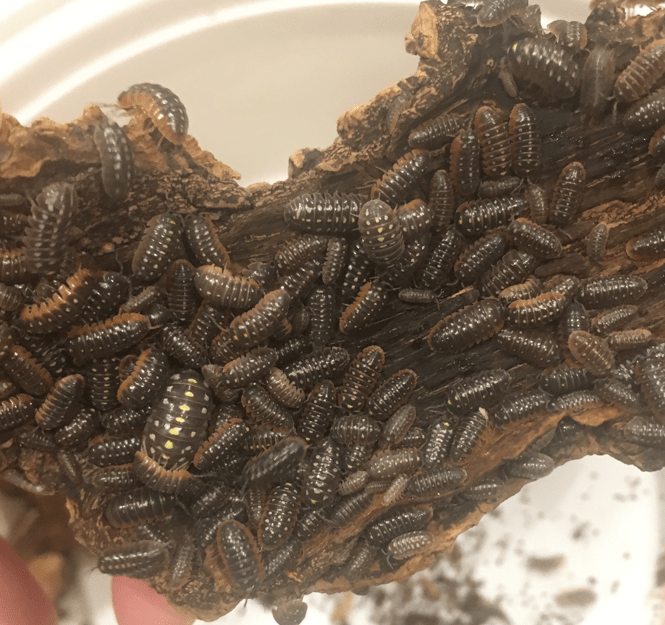
Most of the isopods that this care sheet applies to are prolific breeders, meaning that the 10 you start with can quickly become a few hundred. This can be great news if you are interested in selling them or using them as a cleanup crew in various enclosures, but it can be overwhelming if you are unprepared. For the most part, isopod breeding is very hands off. If there is a male and a female in the same space, all they will need from you is basic maintenance and time.
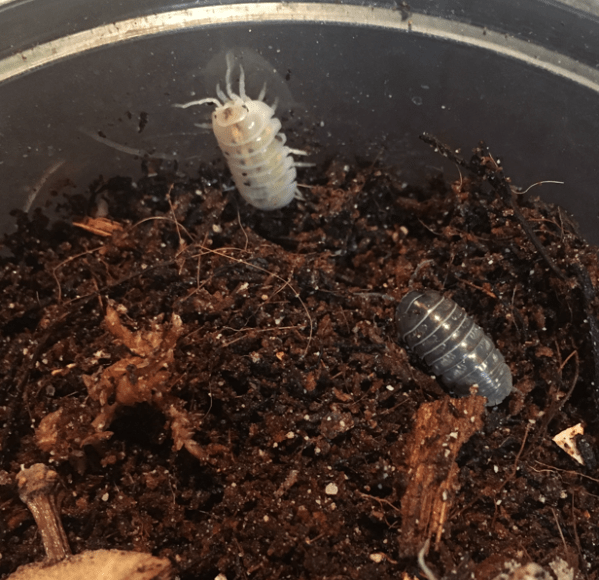
Baby isopods go through three phases in the mother’s marsupium (brood pouch) before you will see them running around the tank. First, they will be released into the marsupium as eggs surrounded by a nutrient rich fluid. After the eggs hatch, they will be tiny larvae (think crab larvae, not grub) swimming/floating around in that fluid. Within the next few weeks, they will pupate into tiny colorless versions of their parents called mancae (mon-kay) at which point they can leave their mother’s pouch and set out on their own. It takes another several weeks for their color to come in and several months to a year for them to have their own babies.
Sexing
Determining the sex of an isopod can be pretty tricky especially with light colored isopods. With Armadillidium like species, the only way to tell other than finding them in the process of mating or seeing a gravid (pregnant) female, is to look at their underside. The easier way is to see if you can see the marsupium on them which would imply a female. Otherwise, there will be a line down the middle of the lower section of scales that can help. In males this line should be more prominent and should be more arched than in females. Even with lighting and magnification this line can be difficult to see and is not necessarily accurate.
Sexing Porcellio like species is much easier and more reliable. On each isopod there will be a pair of leg-like appendages (uropods) sticking out the back. In males these uropods should be noticeably longer than in females. This is best done by comparison between isopods until you are familiar with the species and what you are looking for.
Handling
Most isopods are quite shy and prefer not to be handled, but most will tolerate being held. Given this shyness, their delicate nature, and their need for humidity, handling should be kept to a minimum. It is not recommended to handle gravid mothers except for in emergencies. Being handled can stress out the mom and lead to her ejecting her babies early in an attempt to escape, often these babies will not survive. It is also not recommended to handle molting isopods (will look paler than usual on either their whole body or a half), their shell may not be hardened so they will be prone to being harmed or deformed.
If you do decide to handle your isopods, hold them above a surface so they do not get damaged or lost if they fall, and be very gentle.
Things you May Encounter
- Mold- it is almost guaranteed that you will encounter mold if you keep isopods. In most cases it is harmless to you and your isopods. If you want to reduce the amount present you can remove uneaten food, cut back on amount of extra food given, add springtails, let the enclosure dry out slightly, or any combination.
- Mites- many detritivorous mites enjoy conditions similar to those of isos so may appear in your tank. While some mites can be parasitic and therefore harmful to your isos, these are very uncommon and easy to differentiate. Mites will live on what they eat, so if most of the mites are in the substrate or on leftover food they are almost definitely detritivorous, if they are mostly clustered on your isos (particularly around the legs) they are likely parasitic. Detritivorous can be left alone and may or may not disappear on their own, removing extra food may encourage them to move on. If parasitic mites are detected, the enclosure should be immediately separated from your other colonies and kept away from any invertebrates. I have not personally had to deal with them and am not aware of anyone who has, so am not sure of the best way to treat them.
- Fungal gnats- These small flies tent to appear where ever there is mold or high humidity, so very often can be found in and around isopod enclosures. They are completely harmless to your isopods but may prove annoying to you. I have not yet found an isopod safe way to get rid of or prevent them, but they tend to not live very long outside of the enclosures.
- Predatory arthropods- occasionally unwanted pests can find their way into your bins and may establish themselves. Depending on the creature they may be prevented by having a well-fitting lid for your colony or limiting the amount of food added to the enclosure. I have encountered this twice (due more to poor luck than anything else), with ants and later with centipedes. In both cases the infestation was hunting the mancae in the bin and were treated the same way. First quarantine the infected colony and set up a new enclosure with entirely new substrate. Evacuate the surviving isopods to the new bin, being careful not to move over any of the intruders. Finally bake/sterilize everything in the enclosure. All sticks, hides, calcium sources, etc, must be baked or boiled before adding back into any enclosure. The substrate should be baked and the enclosure should be scrubbed with vinegar or a similar gentle cleaning product to dislodge or destroy any remaining predators or eggs.
- Slime mold- slime mold is a benign organism that may appear. They appear slimy, branching, and can be a variety of colors form yellow to brown to orange. While it may look a little creepy or gross it is perfectly harmless and will feed on bacteria in your enclosure as long as it lives. They are pretty fragile and tend to not live very long in isopod enclosures, so appreciate them while they are there.
- Small worms/nematodes-Nematodes or other small worms may appear in your colony. The vast majority of the time these are just soil worms that feed on mold, left over food, and waste and pose no risk to you or your isopods.
- Improper molting- Sometimes an isopod will fail to remove the old shell when they molt which can lead to deformation and/or, in extreme cases, death. This is not a very common issue but may occur either due to too dry conditions or just bad luck. Unfortunately there is not much that can be done for these isopods.
 Mad Walshs